
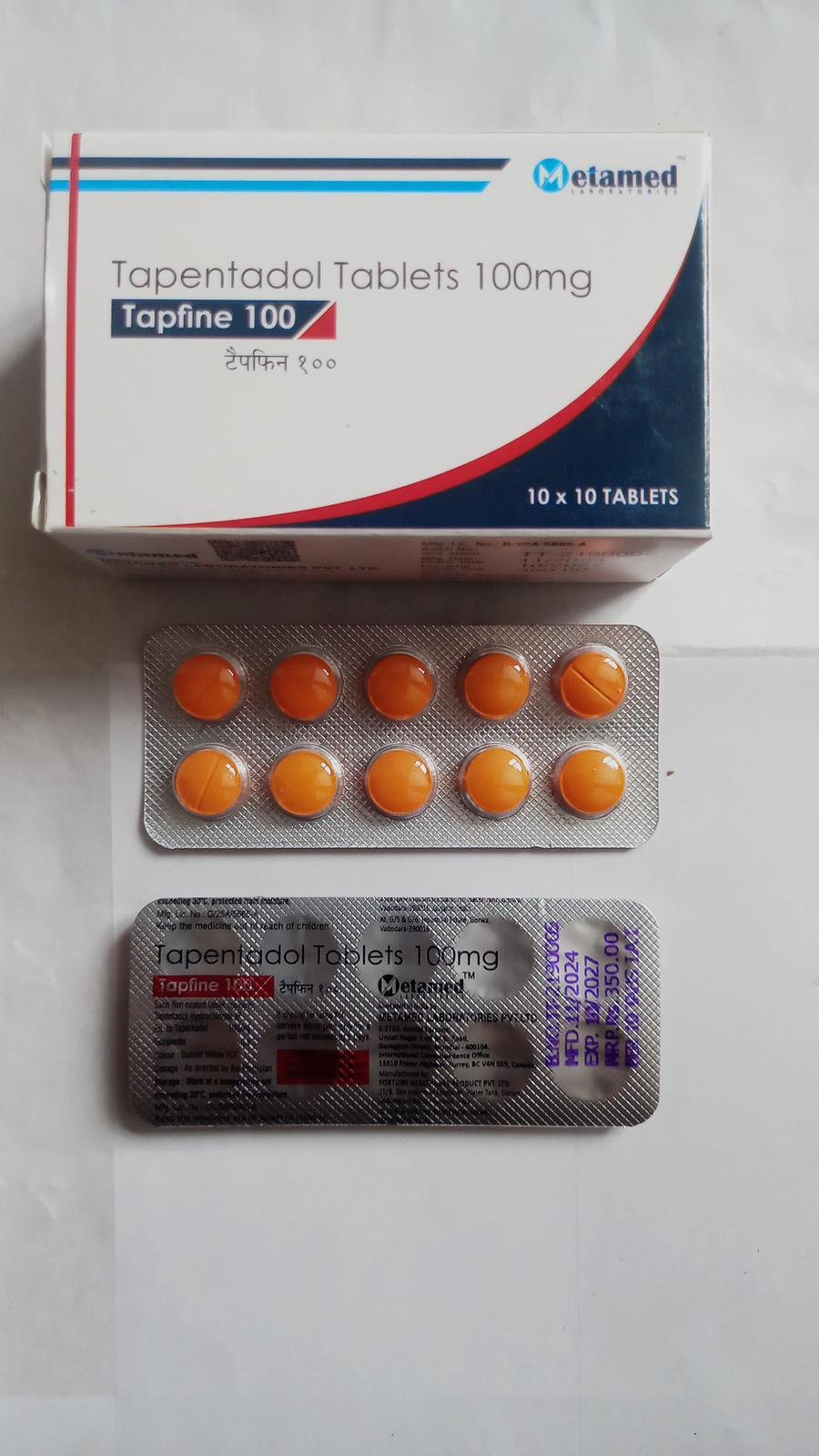
Tapfine 100 (Tapentadol Tablets IP 100 mg) – Advanced Dual-Action Analgesic for Moderate to Severe Pain
Overview
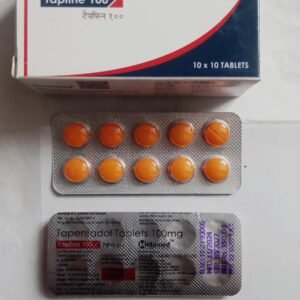
Tapfine 100, manufactured by Metamed Laboratories, contains Tapentadol Hydrochloride 100 mg, a centrally acting analgesic that provides rapid and sustained relief from moderate to severe acute or chronic pain.
Tapentadol represents a new generation of centrally acting opioid analgesics distinguished by its dual mechanism of action—μ-opioid receptor agonism combined with norepinephrine reuptake inhibition (NRI)—offering effective analgesia with improved tolerability and fewer gastrointestinal side effects compared with traditional opioids.
This formulation is manufactured under GMP-certified conditions, ensuring pharmaceutical purity, consistent potency, and patient safety. Each box contains 10 × 10 film-coated tablets, providing a convenient, stable, and clinically reliable pain-management option for healthcare professionals and patients.
Composition
- Active Ingredient: Tapentadol Hydrochloride 100 mg
- Dosage Form: Film-coated oral tablet
- Excipients: Pharmaceutically approved inactive ingredients for stability, absorption, and tablet integrity
- Manufacturer: Metamed Laboratories, India
- Packaging: Blister pack of 10 tablets; 10 × 10 per carton
Therapeutic Class
Centrally Acting Opioid Analgesic / Norepinephrine Reuptake Inhibitor (Dual-Mechanism Analgesic)
Pharmacology and Mechanism of Action
Tapentadol combines μ-opioid receptor agonism (MOR) with norepinephrine reuptake inhibition (NRI), targeting both nociceptive (tissue-injury-related) and neuropathic (nerve-related) pain pathways.
- Opioid Receptor Agonism: Tapentadol binds to μ-opioid receptors in the central nervous system, reducing pain transmission and perception.
- Norepinephrine Reuptake Inhibition: By inhibiting norepinephrine reuptake, it enhances descending inhibitory pain pathways in the spinal cord.
This synergistic dual mechanism allows for effective analgesia at lower opioid receptor occupancy, resulting in reduced risk of opioid-related adverse effects such as nausea, vomiting, and constipation.
Clinical Indications
Tapfine 100 (Tapentadol 100 mg) is indicated for the management of moderate to severe pain where alternative treatment options are inadequate or inappropriate. Clinical uses include:
- Post-operative pain following surgical procedures
- Musculoskeletal pain including back pain, strain, and sprain
- Neuropathic pain associated with diabetic neuropathy and other nerve conditions
- Osteoarthritis and rheumatic pain
- Trauma-related or injury-related pain
- Cancer-related chronic pain where opioid therapy is justified
Tapentadol provides comprehensive control for both acute and chronic pain syndromes, offering healthcare providers flexibility in prescribing based on patient profile and pain intensity.
Pharmacokinetics
- Absorption: Rapid oral absorption with peak plasma concentration achieved in 1.25–1.5 hours.
- Bioavailability: Approximately 32% due to first-pass metabolism.
- Distribution: Extensive tissue distribution; protein binding ≈ 20%.
- Metabolism: Primarily via conjugation (glucuronidation); minimal CYP-mediated metabolism, reducing risk of drug–drug interactions.
- Elimination Half-life: ≈ 4 hours.
- Excretion: Predominantly renal, as metabolites.
The pharmacokinetic profile allows predictable onset and duration of analgesia with a lower risk of accumulation in renal or hepatic impairment compared with older opioids.
Key Clinical Features
- Dual-Mechanism Analgesia – Combines MOR agonism and NRI to manage both nociceptive and neuropathic pain.
- Rapid Onset of Action – Provides effective pain reduction within 30–60 minutes of administration.
- Long-Lasting Relief – Analgesic efficacy sustained up to 8–12 hours, depending on dose and patient response.
- Lower Incidence of GI Side Effects – Reduced nausea, vomiting, and constipation compared with conventional opioids such as tramadol or morphine.
- Minimal Serotonergic Activity – Decreased risk of serotonin-syndrome-related reactions when combined with antidepressants.
- Improved Tolerability and Compliance – Suitable for long-term pain management under supervision.
- Non-CYP-Dependent Metabolism – Fewer drug–drug interactions in patients on polytherapy.
- High Manufacturing Standards – Produced by Metamed Laboratories under stringent GMP and quality-assurance guidelines.
Therapeutic Benefits
- Comprehensive Pain Relief
Tapfine 100 addresses both peripheral and central pain mechanisms, providing balanced analgesia even for neuropathic pain resistant to standard opioids.
- Enhanced Patient Comfort
Its rapid onset and smooth pharmacodynamic profile lead to steady pain control without pronounced sedation or dizziness, enhancing post-operative recovery and patient mobility.
- Improved Quality of Life
By effectively reducing persistent pain, patients regain functional ability, improved sleep, and overall better quality of life.
- Reduced Adverse Effects
Due to its lower affinity for serotonin and histamine receptors, Tapentadol has a safer side-effect profile, minimizing gastrointestinal and cognitive disturbances often associated with opioids.
- Clinically Proven Efficacy
Numerous clinical trials have confirmed Tapentadol’s equivalence or superiority to traditional opioids such as oxycodone or morphine, with better gastrointestinal tolerability.
Dosage and Administration
Note: Dosage must be individualized based on pain severity, prior analgesic experience, and patient clinical condition.
- Typical Adult Dose: Tapentadol 100 mg orally every 12 hours (adjust according to clinical response).
- Initial Therapy: Start with 50–100 mg every 12 hours; may titrate up to 250 mg per day as needed.
- Maximum Recommended Dose: 600 mg per day (acute pain); 500 mg per day (chronic therapy).
- Administration: Tablets should be swallowed whole with water, with or without food.
Do not crush or chew the tablets, as this may alter release characteristics and increase the risk of adverse reactions.
Precautions and Safety Information
- Contraindications: Severe respiratory depression, acute intoxication with alcohol or sedatives, uncontrolled epilepsy, hypersensitivity to Tapentadol.
- Cautions: Use with care in patients with hepatic or renal impairment, respiratory compromise, or history of substance misuse.
- Drug Interactions: Avoid concomitant use with MAO inhibitors or serotonergic agents unless medically justified.
- Pregnancy and Lactation: Use only if potential benefits justify potential risks; consult a qualified healthcare professional.
- Driving and Machinery Use: May cause drowsiness; avoid operating heavy machinery until individual response is known.
Adverse Reactions
Most commonly reported side effects are mild to moderate and transient:
- Dizziness, drowsiness, or headache
- Nausea, constipation, vomiting
- Fatigue or mild sedation
- Dry mouth or sweating
Serious adverse reactions are uncommon when used as directed. Report any signs of respiratory depression or allergic reaction to a healthcare professional immediately.
Clinical Advantages Over Conventional Opioids
| Parameter | Tapentadol (Tapfine 100) | Traditional Opioids |
| Mechanism of Action | Dual (MOR + NRI) | MOR only |
| Onset of Action | Rapid (30–60 min) | Variable |
| GI Tolerance | Improved | Poor |
| Risk of Serotonin Syndrome | Minimal | Moderate |
| Drug–Drug Interactions | Low | Higher (CYP dependent) |
| Sedation Potential | Moderate | High |
| Abuse Potential | Lower than morphine | High |
Tapentadol thus offers a more favorable safety-efficacy balance, making it a rational choice for long-term management of moderate to severe pain.
Storage Instructions
- Store below 25 °C in a dry, dark place.
- Protect from direct sunlight and moisture.
- Keep out of reach of children.
Proper storage ensures tablet stability and potency throughout the shelf life.
Packaging Information
- Pack Size: 10 × 10 film-coated tablets (100 tablets per box)
- Tablet Appearance: Round, biconvex, orange-colored film-coated tablets
- Labeling: Clearly printed batch number, manufacturing date, and expiry date for traceability and authenticity
Quality Assurance
Metamed Laboratories maintains full compliance with Good Manufacturing Practices (GMP) and ISO quality systems, ensuring:
- Precision dosing accuracy
- Purity and potency verification
- Microbiological and stability testing
- Tamper-proof blister packaging
Every batch of Tapfine 100 undergoes rigorous in-house and third-party testing to maintain consistent clinical performance.
Why Choose Tapfine 100 (Tapentadol 100 mg)?
- Scientifically advanced dual-action mechanism
- Faster pain control with prolonged duration
- Reduced risk of opioid-related adverse effects
- Clinically validated for both acute and chronic pain conditions
- Reliable manufacturing from a reputed pharmaceutical company
These attributes make Tapfine 100 an ideal selection for physicians seeking a potent, safe, and well-tolerated analgesic for patients who require sustained pain relief.
Target Audience
- Hospitals and medical institutions prescribing post-surgical and trauma pain therapy
- Orthopedic, neurology, oncology, and pain-management clinics
- Licensed pharmacies and distributors
- Adult patients under medical supervision requiring strong, centrally acting pain relief
Frequently Asked Questions (FAQ)
- What is Tapfine 100 used for?
Tapfine 100 is used to manage moderate to severe pain that cannot be adequately controlled with non-opioid analgesics. It is effective for postoperative, musculoskeletal, and neuropathic pain. - How does Tapentadol differ from other painkillers?
Unlike standard opioids, Tapentadol works via two mechanisms—opioid receptor agonism and norepinephrine reuptake inhibition—providing stronger and broader pain control with fewer gastrointestinal side effects. - Is Tapfine 100 addictive?
Tapentadol has lower abuse potential than morphine or oxycodone, but prolonged unsupervised use should be avoided. Always use under medical supervision. - How long does Tapfine 100 take to work?
Analgesic effects usually begin within 30–60 minutes of ingestion and last up to 8–12 hours, depending on dose and patient factors. - Can Tapfine 100 be used for neuropathic pain?
Yes. Its dual action addresses both nociceptive and neuropathic pain pathways, making it suitable for conditions such as diabetic neuropathy or nerve injury. - Are there side effects?
Most side effects are mild—drowsiness, nausea, constipation—and tend to resolve as the body adjusts to therapy. - Can Tapfine 100 be taken with food?
Yes, it can be taken with or without food. Food does not significantly affect its absorption. - How should Tapfine 100 be stored?
Store at room temperature, away from moisture and direct sunlight, in its original packaging.
Disclaimer
This product information is intended for medical and pharmaceutical professionals. The content herein is for educational and informational purposes only and does not substitute for clinical judgment.
Tapfine 100 (Tapentadol 100 mg) should be used strictly under the guidance of a qualified healthcare provider. Improper or unsupervised use may lead to adverse health effects.
Reviews
There are no reviews yet.