
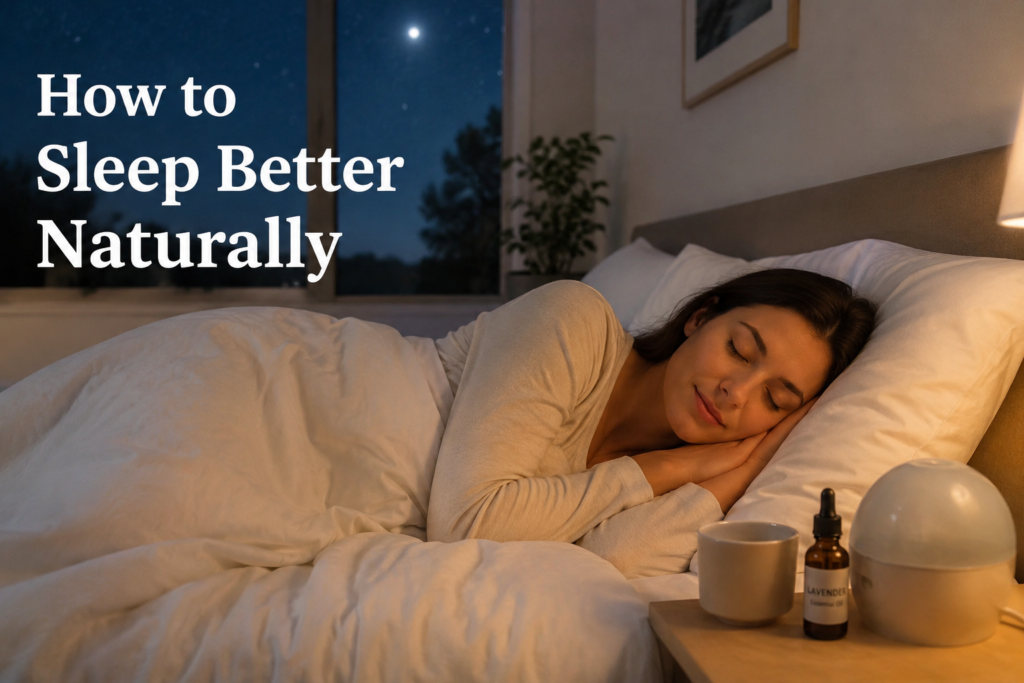
It’s 2am, you’re staring at the ceiling, and you’ve already done the maths on how few hours you’ll get if you fall asleep right now. If that sounds familiar, you’re not alone sleep struggles are one of the most common complaints GPs hear, and most of the time, the fix doesn’t start with a pill. Learning how to sleep better naturally usually comes down to a handful of habits, done consistently, rather than one dramatic change.
In this guide, you’ll learn what’s actually disrupting your sleep, the bedtime routine that works for most adults, which foods genuinely help (and which ones sabotage you), and when it’s worth speaking to a doctor instead of trying another home remedy.
Why Can’t I Sleep at Night? (The Real Reasons)
Most people assume insomnia is random, but it’s almost always traceable to one of a few culprits: light exposure, stress hormones, irregular timing, or stimulants still in your system. Your body runs on a roughly 24-hour internal clock — your circadian rhythm — and it’s far more sensitive to light and routine than most people realise.
Quick Answer: You can’t sleep at night because your circadian rhythm has been disrupted — usually by inconsistent bedtimes, evening screen light, caffeine still in your system, or elevated cortisol from stress. The fix is rebuilding consistent signals (light, timing, temperature) that tell your brain when it’s time to wind down.
Common Mistake: Treating Every Bad Night the Same
I’ve seen this work when clients stop panicking after one poor night’s sleep — because anxiety about not sleeping is often what keeps the cycle going. One rough night rarely matters. It’s the pattern over weeks that does.
How to Improve Sleep Quality Naturally: Start With Light
Light is the single strongest signal your brain uses to decide when to produce melatonin. Get bright natural light within an hour of waking, and dim the lights in your home from around 8–9pm onward.
- Morning: 10–15 minutes outside, even on cloudy UK days, helps anchor your body clock
- Evening: switch to warm, dim lighting instead of overhead bulbs
- Night: keep your bedroom as close to blackout-dark as possible
Best Bedtime Routine for Adults
A good bedtime routine isn’t about rigid rules — it’s about giving your brain consistent, predictable cues that sleep is coming. In practice, the most effective routines I’ve seen follow a similar shape, even when the specific activities differ.
Step-by-Step Wind-Down Routine
- 60 minutes before bed: Dim lights, stop work emails, switch devices to night mode or away entirely
- 30 minutes before bed: Do something calming — reading, light stretching, a warm shower
- 15 minutes before bed: Keep the bedroom cool (around 16–18°C is ideal for most adults)
- At lights out: Same time every night, even on weekends, within a 30-minute window
That said, perfection isn’t the goal. Missing a step occasionally won’t undo your progress — consistency over weeks matters far more than any single night.
How to Fall Asleep Faster Naturally
If you’re lying awake longer than 20 minutes, the most common advice — “just relax” — usually doesn’t work, because trying to force sleep tends to backfire. Instead, focus on lowering your body temperature and slowing your breathing, both of which are physiological triggers your body responds to involuntarily.
Quick Answer: To fall asleep faster naturally, lower your body temperature with a warm shower 1–2 hours before bed, dim lights early, and try slow breathing (4 seconds in, 6–8 seconds out) if you’re lying awake. If you’re still awake after 20 minutes, get up briefly rather than lying there frustrated.
A Technique Worth Trying: The 4-7-8 Breath
Breathe in for 4 seconds, hold for 7, exhale slowly for 8. It’s not magic — it works by activating your parasympathetic nervous system, which is the “rest and digest” counterpart to the stress response keeping you wired.
Foods That Help You Sleep Better (and Ones That Don’t)
Diet plays a bigger role in sleep than most people realise, mainly through its effect on blood sugar and the production of sleep-related hormones like melatonin and serotonin.
Foods Worth Adding
- Tart cherries or cherry juice — one of the few foods with naturally measurable melatonin content
- Kiwi fruit — some small studies link it to improved sleep onset and duration
- Oats, almonds, and bananas — contain magnesium, which supports muscle relaxation
- Herbal teas (chamomile, valerian root) — mild calming effect for many people, though evidence varies
Foods and Habits to Limit
- Caffeine after 2pm (it has a half-life of 5–6 hours, longer than most people assume)
- Alcohol before bed — it helps you fall asleep faster but fragments sleep later in the night
- Large, heavy meals within 2–3 hours of bedtime
Natural Remedies for Poor Sleep: What Actually Has Evidence
Not every “natural sleep aid” on the shelf is backed by solid research, and it’s worth being honest about that. Magnesium glycinate and melatonin supplements have reasonable evidence for specific situations — like jet lag or shift work — but they’re not universal fixes for chronic insomnia.
Quick Answer: Natural remedies with the best evidence include magnesium (for relaxation), low-dose melatonin (for circadian timing issues like jet lag), and CBT-I techniques such as stimulus control. They work best alongside good sleep hygiene, not as a replacement for it.
Cognitive Behavioural Therapy for Insomnia (CBT-I) is, in fact, the treatment the NHS and most sleep specialists recommend before medication — it’s structured, has strong long-term evidence, and addresses the thought patterns that keep people awake.
Sleep Hygiene Practices That Make the Biggest Difference
If you only change three things, prioritise these — they have the most research behind them and the broadest effect.
- Consistent wake time — even more important than bedtime, oddly enough
- Bedroom used only for sleep (and intimacy) — not work, not scrolling
- No naps after 3pm, or keep them under 20 minutes if you do
When Natural Methods Aren’t Enough
Here’s the thing — natural strategies genuinely help most people, but they’re not a cure-all for everyone. If you’ve tried consistent sleep hygiene, light management, and a proper wind-down routine for several weeks and you’re still struggling significantly, that’s a sign worth taking seriously rather than pushing through alone.
Persistent insomnia, especially if it’s affecting your daytime functioning, mood, or safety (like driving), is worth discussing with your GP. They can assess whether something else is going on — anxiety, sleep apnoea, or another condition — and talk through options, which may range from CBT-I referral to, in some cases, short-term prescription support such as zolpidem or zopiclone. These are prescription-only medicines in the UK and aren’t something to start without medical guidance, given the risk of dependency and next-day drowsiness — but they exist as a legitimate option your doctor can properly assess you for.
Conclusion
Sleeping better naturally rarely comes down to one trick — it’s the combination of consistent light exposure, a predictable wind-down routine, and a few diet adjustments that makes the real difference over time. Give any new habit at least two to three weeks before judging whether it’s working, since your body’s rhythm takes time to reset.
If you’ve made genuine changes and you’re still exhausted, that’s not a personal failure — it’s a sign to loop in your GP rather than keep guessing. Either way, better sleep is almost always more achievable than it feels at 2am.Healthy Sleep Tips
FAQ
Q: How long does it take to fix bad sleep naturally?
A: Most people notice improvement within 2–3 weeks of consistent changes, though full circadian rhythm adjustment can take up to a month. The key variable is consistency — sporadic effort tends to produce sporadic results. If you see zero improvement after a month of genuine effort, it’s worth getting checked for an underlying issue like sleep apnoea.
Q: Is melatonin safe to take every night?
A: For short-term use (a few weeks), melatonin is generally considered safe for most adults, but long-term nightly use isn’t well studied. It’s most effective for circadian issues like jet lag rather than general insomnia. In the UK, melatonin is prescription-only, so speak to a pharmacist or GP before starting it.
Q: Why do I wake up at 3am every night?
A: Waking at 3am is often linked to a dip in core body temperature, blood sugar fluctuations, or a brief natural cortisol rise — and becomes a habit when anxiety about it sets in. The good news is this pattern usually responds well to consistent sleep hygiene and stress management. If it persists for weeks, mention it to your GP, as it can sometimes signal sleep apnoea.
Q: Does exercise help you sleep better?
A: Yes, regular exercise is one of the most evidence-backed ways to improve sleep quality, particularly moderate aerobic activity. Timing matters, though — intense exercise within 1–2 hours of bedtime can raise your core temperature and adrenaline, making it harder to wind down. Morning or afternoon workouts tend to work best for sleep.
Q: Can poor sleep cause weight gain?
A: Yes, chronic poor sleep disrupts hunger hormones (ghrelin and leptin), which can increase appetite and cravings for high-calorie foods. It also reduces willpower and increases insulin resistance over time. This is one of the lesser-known reasons doctors take sleep complaints seriously.
Q: Is it bad to look at my phone before bed?
A: Yes, primarily because of the content and stimulation rather than just the blue light itself, though both play a role. Scrolling tends to delay bedtime and keep your brain alert rather than winding down. If you must use your phone, try switching to night mode and avoiding stressful content like news or work emails.
Q: What’s the ideal room temperature for sleep?
A: Most adults sleep best between 16–18°C (60–65°F), as a slightly cool room supports the natural drop in core body temperature needed for sleep onset. This varies by individual, so treat it as a starting point rather than a strict rule. A breathable duvet and good ventilation matter just as much as the thermostat setting.
Q: Are sleep tracking apps and devices accurate?
A: They’re reasonably good at detecting movement and rough sleep duration, but less reliable for measuring sleep stages like deep or REM sleep. Use them for spotting patterns over time rather than trusting any single night’s number. If a tracker makes you more anxious about sleep, it may be doing more harm than good.