
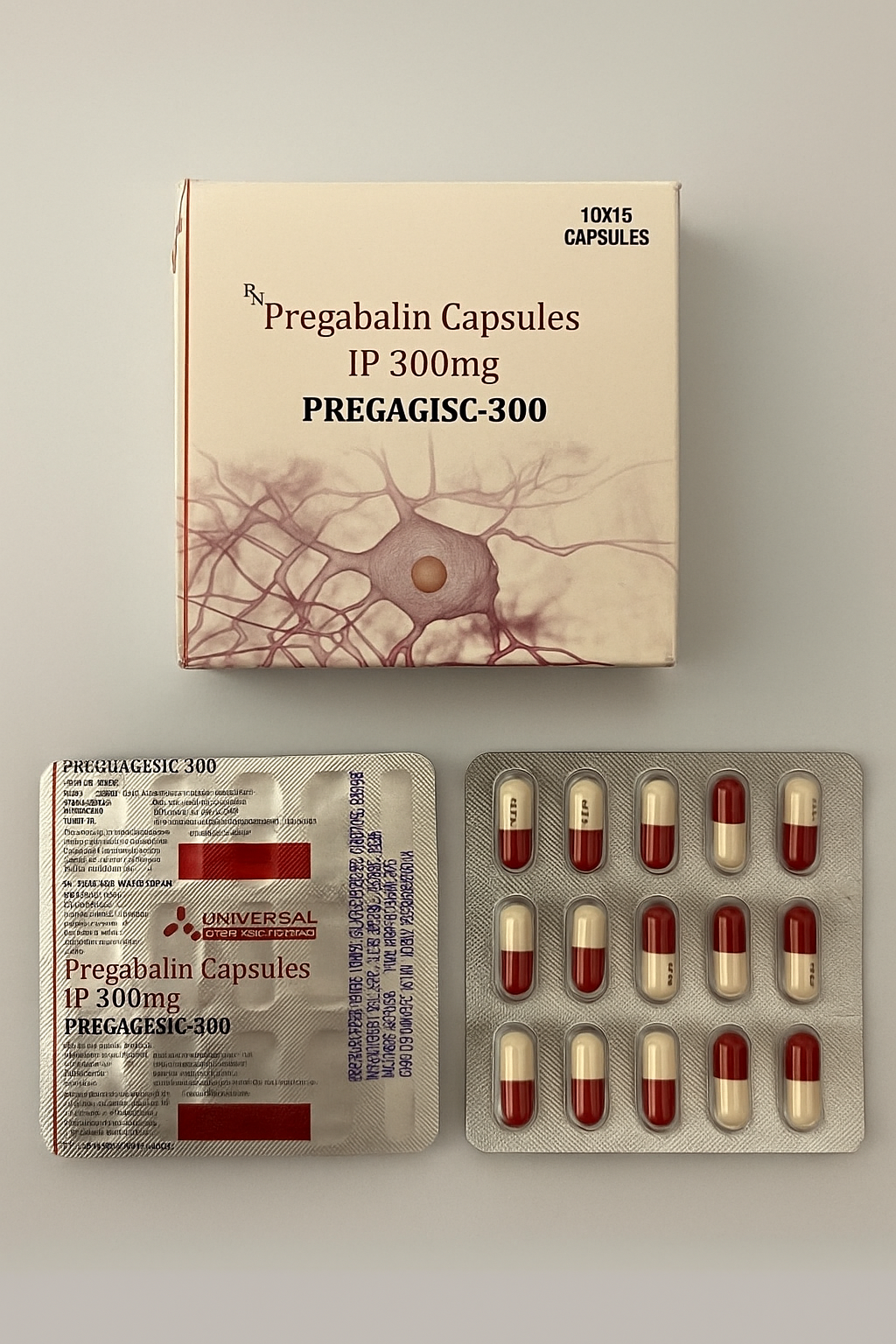
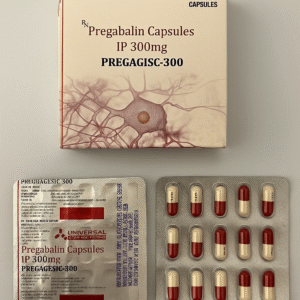
Pregagisc-300 contains Pregabalin 300 mg, a structural analogue of γ-aminobutyric acid (GABA) developed to modulate excitatory neurotransmission in the central nervous system (CNS).
Pregabalin is an antiepileptic, analgesic, and anxiolytic agent indicated for the treatment of neuropathic pain, fibromyalgia, generalized anxiety disorder (GAD), and as adjunctive therapy for partial-onset seizures.
Manufactured under stringent quality standards by Universal Laboratories Pvt Ltd. (India), Pregagisc-300 is formulated for rapid absorption, predictable pharmacokinetics, and stable bioavailability.
Each capsule contains Pregabalin I.P. 300 mg, offering sustained symptom relief and improved quality of life in chronic pain and seizure conditions.
Pharmacological Classification
| Parameter | Details |
|---|---|
| Generic Name | Pregabalin |
| Brand Name | Pregagisc-300 |
| Pharmacologic Class | Anticonvulsant / CNS modulator |
| Therapeutic Category | Neuropathic-pain agent / Anxiolytic / Antiepileptic |
| Mechanism | α₂δ subunit calcium-channel modulation |
| Formulation | Hard gelatin capsule |
| Route of Administration | Oral |
| Dose Strength | 300 mg |
| Manufacturer | Universal Laboratories Pvt Ltd. |
| Prescription Status | Schedule H / Rx only |
Mechanism of Action
Pregabalin binds selectively to the α₂δ subunit of voltage-gated calcium channels in presynaptic neurons of the CNS.
This interaction reduces calcium influx, thereby inhibiting the release of excitatory neurotransmitters including glutamate, noradrenaline, substance P, and calcitonin-gene-related peptide (CGRP).
The result is suppression of neuronal hyperexcitability, leading to:
-
Attenuation of neuropathic pain transmission.
-
Reduction of anxiety-related neurotransmission.
-
Stabilisation of electrical activity in epileptogenic foci.
Although Pregabalin is a GABA analogue, it does not bind directly to GABA-A or GABA-B receptors and does not influence dopamine or serotonin reuptake, distinguishing it from benzodiazepines and antidepressants.
Pharmacokinetic Profile
| Parameter | Characteristic |
|---|---|
| Absorption | Rapid, linear; unaffected by food. |
| Bioavailability | ≥ 90 % across all doses. |
| Tmax | 1 hour (fasting). |
| Distribution Volume | ~ 0.56 L/kg; not protein-bound. |
| Metabolism | Negligible hepatic metabolism; excreted unchanged. |
| Elimination t½ | 6 – 6.5 hours. |
| Excretion | Renal (> 98 % unchanged). |
| Steady State | Reached within 24–48 hours. |
Clinical Implication
Linear pharmacokinetics and renal clearance make Pregabalin dosing highly predictable and suitable for patients with minimal hepatic metabolism concerns.
Therapeutic Indications
Pregagisc-300 is indicated for the management of:
-
Peripheral and Central Neuropathic Pain
-
Diabetic peripheral neuropathy
-
Post-herpetic neuralgia
-
Neuropathic pain associated with spinal-cord injury
-
-
Fibromyalgia
-
Chronic widespread musculoskeletal pain with sleep disturbance
-
-
Adjunctive Therapy in Partial Seizures
-
Focal-onset seizures (with or without secondary generalization) in adults
-
-
Generalized Anxiety Disorder (GAD)
-
Treatment of persistent anxiety characterized by excessive worry and autonomic hyperactivity
-
Dosage and Administration
Pregagisc-300 should be prescribed and titrated under medical supervision.
| Patient Group | Starting Dose | Maintenance Range | Maximum Daily Dose |
|---|---|---|---|
| Adults (Neuropathic Pain) | 75 mg b.i.d. → increase to 150 mg b.i.d. | 300 – 600 mg/day | 600 mg |
| Partial Seizures (Adjunct) | 150 mg/day → increase gradually | 300 – 600 mg/day | 600 mg |
| GAD / Fibromyalgia | 150 mg/day → titrate to 300–450 mg/day | 300 – 450 mg/day | 600 mg |
| Renal Impairment | Dose adjust per creatinine clearance (see table below). |
Renal-Dose Adjustment
| CrCl (mL/min) | Total Daily Dose |
|---|---|
| ≥ 60 | 150–600 mg |
| 30 – 59 | 75–300 mg |
| 15 – 29 | 25–150 mg |
| < 15 | 25–75 mg |
Administration:
Capsules may be taken with or without food. If discontinued, taper gradually over at least 1 week to prevent withdrawal symptoms.
Target Audience
-
Adult patients (≥ 18 years) diagnosed with neuropathic pain, fibromyalgia, or partial seizures.
-
Clinicians managing chronic pain syndromes and anxiety disorders.
-
Patients with diabetic neuropathy or post-herpetic neuralgia unresponsive to NSAIDs or opioids.
-
Neurologists, psychiatrists, and pain specialists requiring a reliable adjunctive anticonvulsant and analgesic.
Clinical Benefits and Therapeutic Outcomes
1. Neuropathic Pain Relief
Pregagisc-300 reduces abnormal neuronal firing and peripheral sensitization, providing measurable improvement in:
-
Pain intensity (Visual Analogue Scale reduction ≥ 40 %).
-
Sleep interference scores.
-
Functional ability and mood.
2. Anxiolytic Effect
By stabilizing calcium-channel activity, Pregabalin decreases over-reactivity in amygdala circuits, resulting in:
-
Reduced somatic tension and worry.
-
Improved social and occupational performance.
3. Antiepileptic Action
Adjunctive use decreases seizure frequency by ≥ 50 % in 40–50 % of patients in clinical trials.
4. Fibromyalgia Management
-
Reduces musculoskeletal pain and fatigue.
-
Improves restorative sleep and physical function.
5. Rapid Onset & Predictability
Symptomatic relief usually begins within 1 week, achieving steady pain control with minimal pharmacologic variability.
Problem Addressed
Neuropathic pain arises from nerve injury or dysfunction, leading to spontaneous pain signals and central sensitization.
Conditions such as diabetic neuropathy, shingles, or spinal trauma create persistent burning, tingling, or shooting pain unresponsive to conventional analgesics.
Pregabalin directly targets this mechanism by modulating presynaptic calcium influx, reducing release of nociceptive neurotransmitters and restoring neuronal balance.
This mechanism also contributes to anxiolytic and anticonvulsant effects, addressing comorbid psychiatric or seizure manifestations often associated with chronic pain syndromes.
Contraindications
-
Hypersensitivity to Pregabalin or formulation excipients.
-
Severe renal impairment without dose adjustment.
-
Pregnancy / lactation (unless clinician-justified).
-
History of substance misuse (use caution).
Warnings and Precautions
-
CNS Depression: May cause dizziness or somnolence; avoid driving or operating machinery.
-
Suicidality Risk: Antiepileptics may increase suicidal ideation; monitor patients closely.
-
Withdrawal Symptoms: Insomnia, headache, nausea; taper gradually.
-
Peripheral Edema / Weight Gain: Common in diabetic neuropathy patients.
-
Vision Disturbances: Blurred or double vision may occur; reversible on discontinuation.
-
Renal Impairment: Dose adjustment mandatory.
-
Abuse Potential: Mild euphoria reported at high doses; monitor for misuse.
-
Concurrent CNS Depressants: Alcohol, opioids, and sedatives enhance sedation and respiratory depression.
Adverse Reactions
| System / Organ Class | Common (>1 %) | Uncommon / Rare |
|---|---|---|
| CNS | Dizziness, somnolence, headache | Confusion, ataxia, tremor |
| Psychiatric | Euphoria, irritability | Hallucination, mood swings |
| Gastrointestinal | Dry mouth, constipation | Nausea, vomiting |
| Metabolic | Weight gain, increased appetite | Hyponatremia |
| Musculoskeletal | Fatigue, myasthenia | Arthralgia |
| Ocular | Blurred vision, diplopia | Vision loss (reversible) |
| Cardiovascular | Peripheral edema | Tachycardia |
| Reproductive | Erectile dysfunction | Menstrual irregularity |
Most reactions are dose-dependent and subside upon tapering or discontinuation.
Drug Interactions
| Interacting Agent | Interaction Type | Clinical Effect / Recommendation |
|---|---|---|
| CNS depressants (alcohol, benzodiazepines, opioids) | Pharmacodynamic | Additive sedation → avoid or monitor closely |
| Antidiabetic agents (pioglitazone, rosiglitazone) | Pharmacodynamic | Enhanced peripheral edema; monitor weight |
| ACE inhibitors | Pharmacodynamic | Possible angioedema risk |
| Renally cleared drugs | Pharmacokinetic | Adjust doses in renal impairment |
| No P450 induction/inhibition | — | Minimal drug–drug interactions overall |
Clinical Efficacy Summary
Randomized, placebo-controlled studies demonstrate:
-
≥ 50 % pain reduction in up to 45 % of patients with diabetic neuropathy.
-
Sleep quality improvement scores ↑ by 30–40 %.
-
Anxiety symptom reduction on Hamilton Anxiety Rating Scale (HAM-A) ≥ 10-point mean decrease.
-
Seizure frequency ↓ ≥ 40 % in partial-onset epilepsy cohorts.
These results confirm Pregabalin’s broad CNS efficacy, predictable pharmacokinetics, and favorable tolerability.
Storage and Handling
-
Store at below 30 °C in a dry, dark place.
-
Keep in original blister packaging until administration.
-
Shelf life: 24 months from manufacturing date.
-
Keep out of reach of children.
Counselling and Patient Education
Healthcare professionals should instruct patients to:
-
Take doses at consistent times daily.
-
Avoid abrupt discontinuation.
-
Refrain from alcohol or sedative co-use.
-
Report any mood changes or suicidal ideation.
-
Maintain adequate hydration to reduce dizziness.
-
Expect symptom relief typically within one week.
-
Continue adjunctive non-pharmacologic measures (physiotherapy, glycemic control, psychotherapy).
Pregnancy and Lactation
-
Pregnancy Category C: Animal studies show reproductive toxicity; human data insufficient.
-
Lactation: Pregabalin is excreted in breast milk; use only if potential benefit outweighs risk.
Overdose Management
Symptoms: Drowsiness, agitation, confusion, and seizures.
Treatment: Supportive + symptomatic care. Hemodialysis effectively removes Pregabalin (≈ 50 % reduction after 4 hours).
Conclusion
Pregagisc-300 (Pregabalin Capsules I.P. 300 mg) represents a clinically validated therapy for multiple neurologic and pain-related disorders.
Through selective α₂δ-subunit calcium-channel binding, Pregabalin modulates aberrant neuronal activity to deliver consistent relief from neuropathic pain, fibromyalgia, anxiety, and partial seizures.
Its favorable safety profile, linear pharmacokinetics, and broad-spectrum efficacy make it a cornerstone in chronic pain and seizure management under medical supervision.
Reviews
There are no reviews yet.